Could One of Jupiter’s Moons Support Alien Life? U-M Scientists Are on the Case

Europa Clipper
NASA’s Europa Clipper, the organization’s latest mission to Jupiter’s system of moons, launched from Florida’s Kennedy Space Center. It’s the start of a grand journey to Europa, a moon that scientists believe has a salty ocean of water beneath its icy outer surface. When the spacecraft reaches its target in 2031, it will start collecting the data necessary for University of Michigan researchers to help determine whether the ocean could support life.

First Data from XRISM Space Mission Provides New Perspective on Supermassive Black Holes

black hole
Some of the first data from an international space mission is confirming decades worth of speculation about the galactic neighborhoods of supermassive black holes. More exciting than the data, though, is the fact that the long-awaited satellite behind it—the X-Ray Imaging and Spectroscopy Mission or XRISM—is just getting started providing such unparalleled insights.

In Six New Rogue Worlds, Webb Telescope Finds More Star Birth Clues

stars
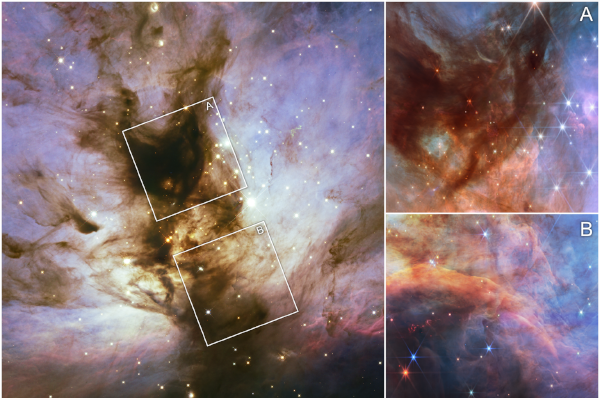
An international collaboration that included the University of Michigan has spotted six likely rogue worlds—objects with planetlike masses but untethered from any star’s gravity—using the James Webb Space Telescope, or JWST. The discovery includes the lightest rogue planet candidate ever identified with a dusty disk around it. The elusive objects offer new evidence that the same cosmic processes that give birth to stars may also play a common role in making objects only slightly bigger than Jupiter.