Could One of Jupiter’s Moons Support Alien Life? U-M Scientists Are on the Case

Europa Clipper
NASA’s Europa Clipper, the organization’s latest mission to Jupiter’s system of moons, launched from Florida’s Kennedy Space Center. It’s the start of a grand journey to Europa, a moon that scientists believe has a salty ocean of water beneath its icy outer surface. When the spacecraft reaches its target in 2031, it will start collecting the data necessary for University of Michigan researchers to help determine whether the ocean could support life.

NASA Selects U-M Team to Develop Technologies to Enhance Artemis Missions

Xhab logo
NASA and the National Space Grant Foundation have selected several university teams to develop advanced and innovative design ideas that will help solve Artemis mission challenges, including the BLISS (Bioastronautics and Life Support System) team at the University of Michigan. The selections are part of the 2023-2024 Moon to Mars eXploration Systems and Habitation (M2M X-Hab) Academic Innovation Challenge sponsored by NASA’s Artemis Campaign Development Division.

Enduring the Fireball of Spacecraft Re-entry through Improved Radiative Heating Prediction

earth
When we think about space missions, our minds often drift to unforgettable moments from the Apollo missions, the Space Shuttle Orbiter, or blockbuster movies. Among the many lasting memories from these endeavors, the image of the spacecraft engulfed in fiery plasma before safely landing back on Earth may be the most significant, as it symbolizes a successful mission. At the University of Michigan Department of Aerospace Engineering, researchers are working to better understand the complex scientific and engineering efforts behind these awe-inspiring scenes to ensure our astronauts continue to get home safely.

NASA Announces Winners of Inaugural Human Lander Challenge

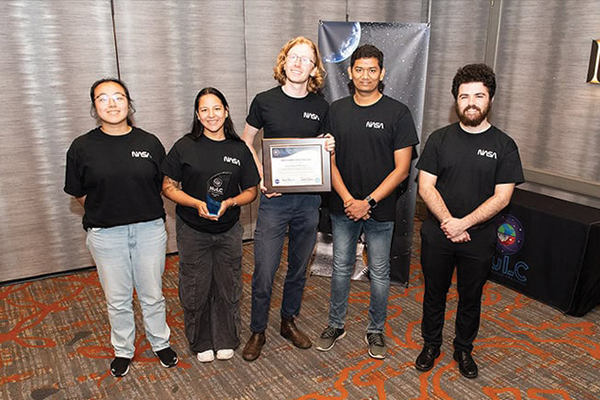
HULC winners
On June 27, 2024, NASA announced the University of Michigan team to be the winner of the inaugural Human Lander Challenge, a challenge designed to provide solutions for landing humans on the moon. NASA’s 2024 Human Lander Challenge (HuLC) Forum brought 12 university teams from across the United States to Huntsville, Alabama, near the agency’s Marshall Space Flight Center, to showcase their innovative concepts for addressing the complex issue of managing lunar dust.