
In an article for space.com, Dr. Eric Bell, a professor at the University of Michigan Department of Astronomy, talks about how galaxies Andromeda XXXV and Andromeda could change how we think about cosmic evolution. He was interviewed in the article “Scientists discover smallest galaxy ever seen: ‘It’s like having a perfectly functional human being Continue Reading »
Tag: space
What Industry Wants: Model-Based Systems Engineering

George Halow, a professor of practice at Michigan Aerospace Engineering, launched a model-based systems engineering course that takes students from customer concept to design or prototype inside two semesters, often mentored by engineers at big name corporate sponsors.
Small, Faint and ‘Unexpected in a Lot of Different Ways’: U-M Astronomers Make Galactic Discovery

A discovery made by a team led by researchers at the University of Michigan tugs at the seams of some key cosmic lessons we thought we had learned from our own galaxy. This dwarf galaxy, named Andromeda XXXV and located roughly 3 million light-years away, is forcing astronomers to rethink how galaxies evolve in different cosmic environments and survive different epochs of the universe.
U-M Astronomers Peer Deeper into Mysterious Flame Nebula
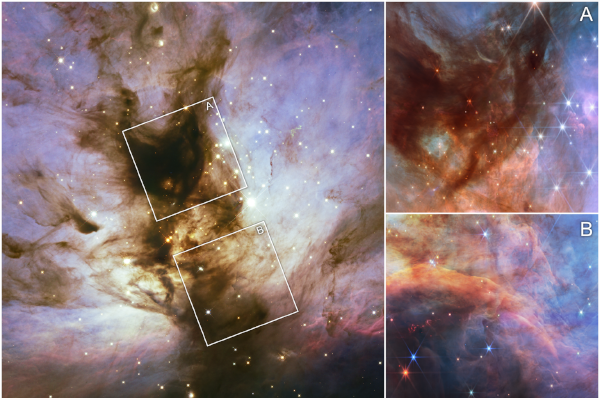
Using NASA’s James Webb Space Telescope, or JWST, a team of researchers, including astronomers from the University of Michigan, are closing in on the answer to a looming cosmic question.
In probing the Flame Nebula, they’re finding out what’s the smallest celestial body that can form on its own from clouds of gas and dust in space.
“Former NASA Rocket Scientist Aisha Bowe to Make History as Crew Member on Blue Origin’s First All-Woman Spaceflight”
In an article for BecauseOfThemWeCan.com, Aisha Bowe, a U-M Climate & Space alumna, talks about her announcement that she will be part of Blue Origin’s NS-31 mission, making history as one of six women flying together on the 11th human spaceflight of New Shepard. She was featured in the article “Former NASA Rocket Scientist Continue Reading »
“Flight, Space and Rockets Pay a Visit to a School in Milan”
Students from the University of Michigan Department of Aerospace Engineering, were featured in the Sun Times News about their visit to Symons Elementary School in Milan, MI. The article was titled “Flight, Space and Rockets Pay a Visit to a School in Milan.” | February 28, 2025
“U-M Department of Astronomy’s First Satellite Launch Could Pave the Way for Exoplanet Discoveries”
In an article for The Michigan Daily, Dr. John Monnier, a professor at the University of Michigan Department of Astronomy, talks about the STARI Mission and how interferometers in space could allow scientists to study exoplanets in greater detail than they are currently able with existing technology. He was interviewed in the article “U-M Continue Reading »
U-M Awarded up to $7.5M to Bring Heat-Tolerant Semiconductors From Lab to Fab

Heat-resistant sensing and computing chips made of silicon carbide could advance aircraft, electric and gas-powered vehicles, renewable energy, defense and space exploration—and University of Michigan researchers are leading a multimillion dollar collaborative effort to bring more of them to market.
Funded by the Silicon Crossroads Microelectronics Commons Hub, the project is launching with $2.4 million in initial funding, and could receive up to $7.5 million over three years.
“U-M Department of Astronomy Prepares its First NASA Mission”
In an article for WEMU.org, Dr. John Monnier, a professor at the University of Michigan Department of Astronomy, talks about the STARI Mission and how it should make the study of planets out of our solar system less expensive. He was interviewed in the article “U-M Department of Astronomy Prepares its First NASA Mission Continue Reading »
U-M Astronomy Will Lead Its First Satellite Mission With NASA Grant
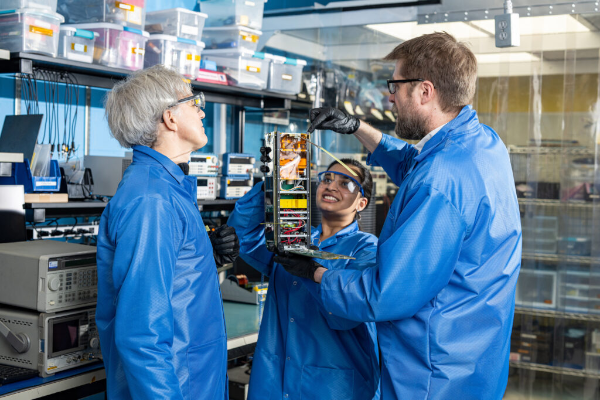
The first space mission led by the University of Michigan Department of Astronomy is scheduled to launch in 2029 with the support of a NASA grant worth $10 million. The mission is called STARI—STarlight Acquisition and Reflection toward Interferometry—and will showcase the viability of a new technique for studying exoplanets, or planets outside of our solar system.