
The Space Physics Research Laboratory was featured in an article on Fox2Detroit.com titled “University of Michigan Partners with NASA to Study Venus in Unprecedented New Mission,” for its work building a mass spectrometer that can survive the hottest planet in the solar system. | April 2023
U-M Aerospace Assistant Professors Receive START Grant

Four faculty members in the Aerospace department received a START grant from Michigan Engineering. The project goal is to expand the environmental, emissions, and community impact considerations of the planning process for launch sites.
U-M Hosts NASA PI Launchpad Workshop

The NASA Science Mission Directorate, the Heising-Simons Foundation, and a group of mission experts have teamed up to make the mission development process more transparent and accessible to researchers, by offering the NASA PI Launchpad workshop.
An Eye on the Sky: U-M Astronomy Contributes Instrumentation to Extremely Large Telescope
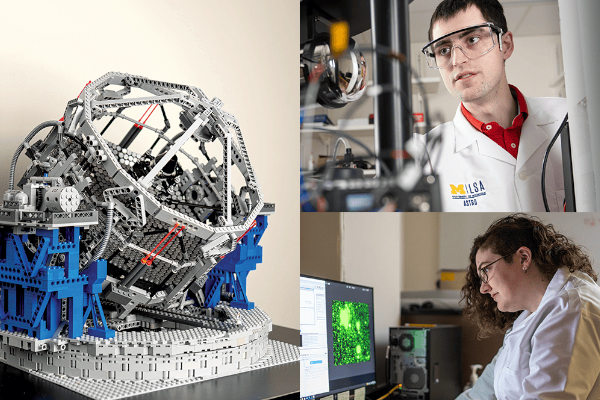
The Extremely Large Telescope could change everything we know about the Universe—including how the first galaxies were created and where life on other planets may exist. And U-M is the only U.S. university involved in helping develop it.
“The Harshest Reality: Exploring Active Radiation Shielding”
As missions prepare to take humans to the moon or Mars, scientists must confront “The Harshest Reality” of outer space: It’s full of radiation from our sun and beyond. Scientists at the University of Michigan and NASA are exploring the possibility of using ‘active shielding’ to generate electromagnetic or electrostatic fields that could divert much Continue Reading »
Tracking Ocean Microplastics from Space

New information about an emerging technique that could track microplastics from space has been uncovered by researchers at the University of Michigan. It turns out that satellites are best at spotting soapy or oily residue, and microplastics appear to tag along with that residue.
NEMISIS Investigation Selected for NASA GDC Mission

In January, NASA selected the final investigations for the Geospace Dynamics Constellation (GDC) Mission. The two investigations for the flagship mission include the Thermal Plasma Sensor and NEMISIS (Near Earth Magnetometer Instrument in a Small Integrated System), led by University of Michigan Prof. Mark Moldwin.
New Laboratory To Support Research and Mission Planning

A new laboratory is coming to the U-M Department of Climate and Space Sciences and Engineering, slated to be completed by 2024. Named the Leinweber Space Innovation Laboratory, the lab will support space research, mission planning and learning.
New from JWST: An Exoplanet Atmosphere as Never Seen Before

NASA’s JWST has scored another first in its release of stunning images: a molecular and chemical portrait of a distant world’s skies.
Student-led Cubesat Project Being Deployed from the International Space Station
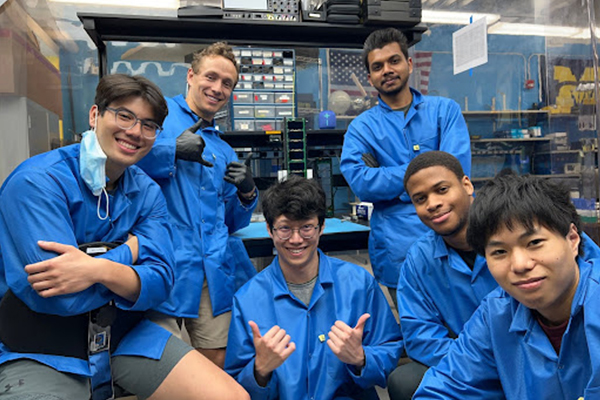
An upcoming SpaceX Falcon 9 resupply mission to the International Space Station will carry more than Tang for the astronauts. The November launch also carries a cubesat created by University of Michigan Master’s students.