
In an article for The University Record, Edward H. White II, a 1959 graduate of the University of Michigan, was featured about being the first American to walk in space. His story was featured in the article “It Happened at Michigan: U-M Alum was First American to Walk in Space.” | June 23,
NASA Announces Lepri Will Serve as SunRISE Mission Lead

In June, NASA announced that Professor Sue Lepri, who works as the director of the Space Physics Research Laboratory and a professor at the University of Michigan Department of Climate and Space and Engineering, is taking over as the Principal Investigator of the SunRISE Mission, or the Sun Radio Interferometer Space Experiment.
Professors from U-M Law and U-M Aerospace Co-Instruct Course on Removing Space Debris

The Problem Solving Initiative (PSI) course series, where students from a variety of academic backgrounds come together and learn how to collaborate and solve problems, recently drew its latest iteration to a close with an end-of-semester presentation and forum.
This semester’s PSI was co-taught by U-M Law School Professor Donald Moore and U-M Aerospace Engineering Assistant Professor Oliver Jia-Richards and covered the topic of how to handle and remove debris from space.
The People Behind SPAR: Eric Viges

As one of the key players the new Space Power and Propulsion for Agility, Responsiveness and Resilience (SPAR) Institute, Eric Viges is taking on the technical leadership role as head of the institute’s power division. With this, he will be coordinating different elements of the power side to bring together sub team members and do systems demonstrations in Year 2 and Year 5 of the project.
H3D Detectors Arrive at the International Space Station

Radiation detectors developed by Ann Arbor-based startup H3D, Inc.—founded by University of Michigan researchers—were launched to the International Space Station (ISS) early Monday morning as part of NASA’s latest resupply mission. The payload was carried aboard SpaceX’s 32nd cargo delivery flight to the ISS, which lifted off April 21 at 4:15am EDT from Kennedy Space Center in Florida. The capsule successfully arrived at the ISS the following morning, docking with the station at 8:40am EDT on April 22.
“Sunscreen, Clothing and Caves May Have Given Modern Humans an Edge Over Neanderthals When Earth’s Magnetic Field Wandered”
Lead Author and U-M Climate and Space Alumnus Dr. Agnit Mukhopadhyay was interviewed for the article “Sunscreen, Clothing and Caves May Have Given Modern Humans an Edge Over Neanderthals When Earth’s Magnetic Field Wandered” in Smithsonian Magazine. The article covers the paper “Wandering of the auroral oval 41,000 years ago” which has been published in Continue Reading »
Alumna Aisha Bowe Ready to Launch on Historic All-Women Space Flight
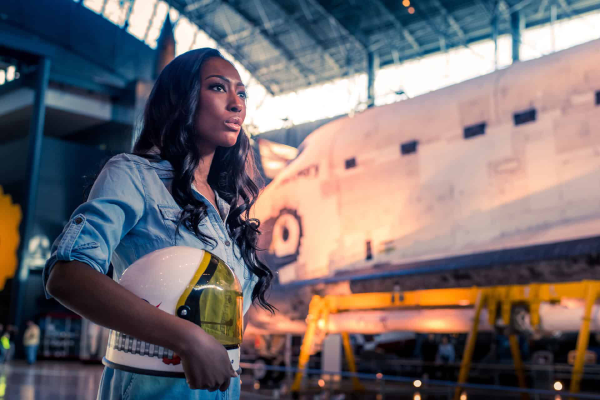
Aisha Bowe, an alumna from Michigan Aerospace, is set to board the first-ever all-women Blue Origin flight, scheduled to launch on April 14, 2025. This historic flight will be Blue Origin’s 11th human space mission that will cross the Kármán line – the internationally recognized boundary between Earth’s atmosphere and outer space, 62 miles (100 km) above Earth.
New FireSat Set to Transform Wildfire Detection and Response

The first prototype of the FireSat constellation launched into low-Earth orbit in March, paving the way for a large network of satellites that will help enhance wildfire detection, mitigation and response around the world.
The entire constellation will eventually consist of 50 satellites that will use infrared cameras to detect and track wildfires from space. They will also use a next-generation Global Navigation Satellite System Reflectometry (GNSS-R) receiver that can measure soil and vegetation moisture based on how the surface reflects GPS microwaves, harnessing signals already bouncing off the Earth from navigation satellites.
Power Grant Awarded to Noah Vogel
Noah Vogel, a U-M Aerospace Engineering student, was awarded a U-M Space Institute Power Grant in the amount of $5,000, for his project “BLiSS Volatile Organic Compound (VOC) Deposition Project” in March 2025.
“The Bioastronautics and Life Support Systems team (BLiSS) is a student-led organization at the University of Michigan focused on developing technologies Continue Reading »
“NASA’s Parker Probe Just Flew Through Solar Fire at 430,000 MPH”
The NASA Parker Solar Probe, a mission led by Principal Investigator Dr. Justin Kasper of the University of Michigan Department of Climate and Space, was featured on SciTechDaily.com about completing its 23rd close encounter with the Sun. The probe was featured in the article “NASA’s Parker Probe Just Flew Through Solar Fire at 430,000 Continue Reading »